13. Basis functions#
Hierarchical basis using lowest order, plus bubbles
Basis for higher order tensor-fields
Here: 3D case
13.1. Basis functions for \(H^1\):#
continuous functions
vertex basis: barycentric coordinatges \(\lambda_i\)
edge, face, cell bubbles: scalar-valued polynomial functions depending on barycentric coordinates
\[u_i(\xi), \quad u_i(\xi) v_j(\eta), \quad u_i(\xi) v_j(\eta) w_k(\zeta)\]
13.2. Basis functions for \(H(\operatorname{curl})\):#
tangential-continuous functions
lowest order Whitney forms: \(\lambda_i d\lambda_j - \lambda_i d \lambda_j\)
high order: \(d u_i, u_i d v_j - v_j du_i\)
forms can be canonically restricted to facets (see course by Ralf)
Implemented in Euklidean space: \(u_i dv_j - v_i du_j = u_i \nabla v_j - v_j \nabla u_i\)
See thesis Sabine Zaglmayr, 2006 for various element shapes (trigs, quads, tets, prisms, hexes)
13.3. Basis functions for \(H(\operatorname{div})\):#
normal-continuous functions
lowest order Whitney forms: \(\lambda_i d\lambda_j \wedge d \lambda_k + \lambda_j d\lambda_k \wedge d\lambda_i + \lambda_k d\lambda_i \wedge d\lambda_j\)
high order: \(u_i dv_j \wedge dw_k\)
two-forms, identified with vectors \(\nabla \lambda_i \times \nabla \lambda_j\) in \({\mathbb R}^3\)
13.4. Matrix-valued spaces (high order tensors with symmetries)#
13.4.1. Regge space \(H(\operatorname{curl curl})\):#
\(tt\)-continuous matrix fields
lowest order: \(d \lambda_i \odot d \lambda_j\) (symmetric product)
high order: \(u_i v_j w_k d \lambda_i \odot d \lambda_j\)
Snorre Christiansen 2011, Lizao Li 2018, Michael Neunteufel 2021
13.4.2. MCS space \(H(\operatorname{curl div})\)#
\(nt\)-continuous matrix fields:
\((d u_i \wedge d v_j) \otimes d w_k\)
3-tensors with skew-symmetry are identified with 2-tensors \(A\) (matrices):
Bianchi identity leads to trace-free matrices
Theses Philip Lederer, 2019
13.4.3. TDNNS space \(H(\operatorname{div div})\)#
\(nn\)-continuous matrix fields:
\((d u_i \wedge d v_j) \odot (d w_k \wedge d u_i)\)
4-forms with skew-symmetries are identified with symmetric 2-tensors (matrices):
Theses Astrid Sinwel (aka Pechstein), 2009
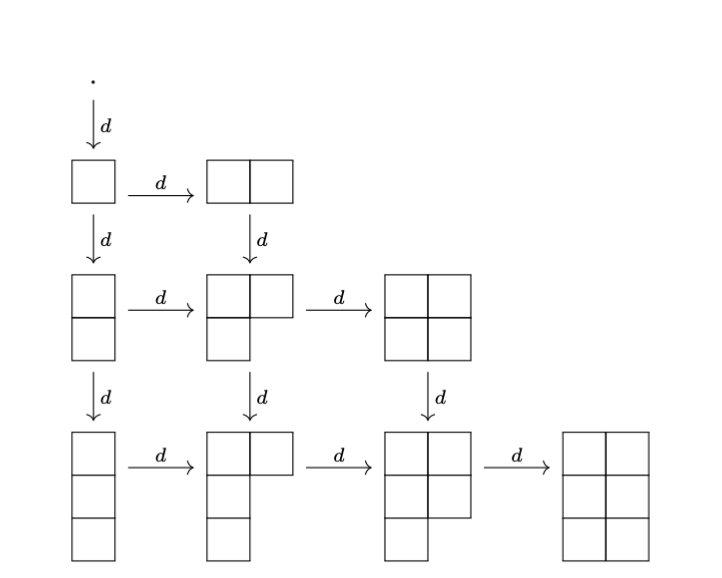
13.5. Related to Young-tableaux#
Kaibo has seen the connection to boxes from representation theory (Young tableaux):
number of boxes = order of tensor
horizontal boxes = symmetric tensors
vertical boxes = alternating tensors (\(k\)-forms)